
A Million Ways to Die as a Pest
The second major region, Turquoise Dawn, is a sprawling alien jungle that houses a fascinating blend of an Orcish tree-top settlement and a wooden Imperial outpost. It is visually stunning and feels entirely distinct from The Wall, both in appearance and layout. Here, players are far more likely to meet their end through environmental mishaps or attacks from the local wildlife than from enemy soldiers. The final major location is the ruined tower of Akenash—the complete setting of the original Styx game—now transformed into a twisted post-apocalyptic landscape teeming with magical monstrosities and roaming groups of Dark Elves searching for ancient relics.
Akenash is particularly compelling for anyone familiar with 2014’s Styx: Master of Shadows, which I reviewed years ago and revisited recently in preparation for this release. It showcases one of the most remarkable things that only video game sequels can truly achieve: allowing players to revisit a familiar location through a completely different lens, altered by time, catastrophe, or both. In Blades of Greed, Akenash is instantly recognizable as a shattered version of the original game’s environments. The areas are now viewed from entirely new perspectives thanks to floating islands and Styx’s growing collection of traversal abilities, which are unlocked gradually throughout the story. These mechanics provide the game’s Metroidvania-inspired progression system.
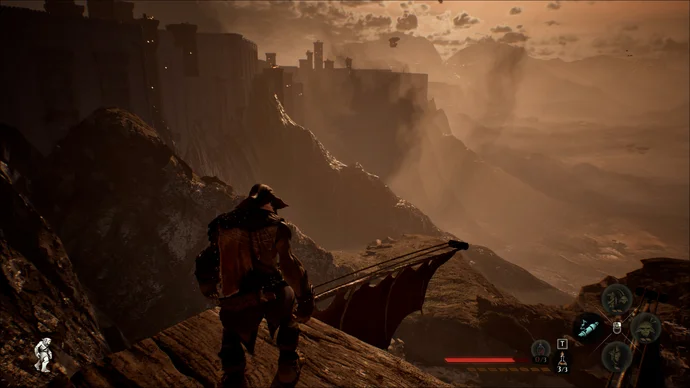
Elements borrowed from various iconic games can be felt throughout the experience. Whether it’s Batman’s grappling mobility, Link’s gliding freedom, or Corvo’s short-range teleportation, Styx gradually gains a versatile toolkit that opens access to increasingly larger sections of each map. The world unfolds at a carefully measured pace, expanding with elegance and precision, creating a progression system that feels both rewarding and expertly balanced.
To advance from one act to the next, players must collect a specific number of quartz shards. This transforms what would normally be considered a secondary objective in a modern Assassin’s Creed title into the primary focus of progression. Rather than overwhelming players with endless icons and checklist activities, the game presents a concise set of objectives while offering extraordinary freedom in how those goals are achieved.
Throughout my playthrough, I discovered numerous alternative methods for overcoming obstacles. Entire sections can often be bypassed through careful exploration and smart use of Styx’s “amber vision.” This detective-style ability relies on amber, a mysterious substance introduced in the first game. Amber serves both as a magical resource and a narcotic, and Styx’s dependency on it remains a defining aspect of his character.
The game consists of five main story acts. Between them are more linear, heavily scripted stages designed to introduce newly unlocked traversal mechanics while simultaneously showcasing unique environments that appear only once throughout the adventure. Thankfully, the series has not fully embraced the open-world trend. Instead, its structured approach of expanding and narrowing the scope at carefully selected moments keeps the experience engaging. In many ways, this design philosophy makes the world feel larger and more memorable than many fully open-world games manage to achieve.
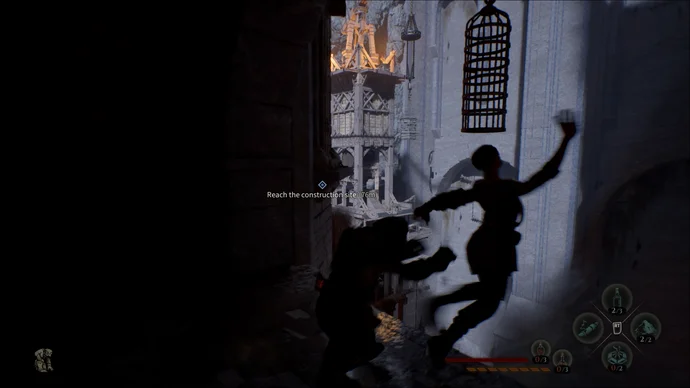
Where the game stumbles somewhat is in its cutscenes. They are necessary for advancing the story, but they often come across as unintentionally awkward. Part of the problem stems from technical issues that have plagued Unreal Engine productions since the Xbox 360 era. However, the larger issue lies in the voice acting, which is disappointingly inconsistent.
Many performances accomplish the bare minimum but lack any real personality or emotional depth. Some lines sound as though they are being read with exactly the same enthusiasm one might use to recite a weather report. Other performances are simply poor, feeling badly cast and awkwardly delivered in a way that resembles an amateur school production. Combined with Unreal Engine’s familiar visual quirks—such as noticeable scene redraws during camera transitions, misplaced audio cues, and various other small technical irritations—the cinematic portions rarely leave a positive impression.
Fortunately, cutscenes occupy only a small fraction of the overall experience. This is not Metal Gear Solid, after all. When it comes to pure gameplay, Blades of Greed excels.
Traversal is exhilarating, constantly encouraging players to perform daring acrobatic maneuvers across vast distances. Styx can execute impossible ledge grabs, ride powerful air currents high into the sky, and navigate environments with an agility that feels genuinely thrilling. At the same time, the smaller-scale stealth gameplay remains equally satisfying. Crawling beneath tables, scaling walls, slipping through drains, and carefully positioning yourself for the perfect theft or assassination all contribute to a constant feeling of mastery.
Styx’s extensive collection of magical abilities adds another layer of enjoyment. Many of these powers create those wonderful moments where a game convinces you that you have completely outsmarted your opponents. Few experiences are as satisfying as orchestrating the perfect crime: dropping a chandelier at precisely the right moment, creating a distraction to lure guards away, or mind-controlling an armored enemy and guiding them toward an unfortunate death. As long as you have amber available, the possibilities feel delightfully endless.
Yet some of the most exciting moments occur when amber is in short supply.
When you cannot simply manipulate every situation with magic. When summoning a clone to pull a distant lever is no longer an option. When every special ability must be conserved because resources are scarce. During these moments, Blades of Greed reveals its greatest strength.
Many encounters force players to rely entirely on the fundamental principles of stealth: hiding, observing enemy behavior, exercising patience, and choosing the perfect moment to act. Every challenge can be overcome using these core mechanics alone. Likewise, every careless mistake that escalates into open combat is likely to result in death.
This commitment to stealth is what makes Styx 3 feel like a genuine stealth game in the purest sense. Unlike many modern franchises that have gradually shifted toward action-oriented gameplay, stealth here is not optional. Games like Assassin’s Creed still talk extensively about the virtues of shadows and silence, but they ultimately allow players to ignore those mechanics entirely in favor of direct combat. That is not the case here.
For players who genuinely enjoy sneaking, planning, and outsmarting enemies rather than engaging in straightforward battles, Blades of Greed delivers exactly what they have been waiting for. Despite moving toward a somewhat broader and more open structure, the game avoids unnecessary bloat. Whether through careful creative discipline or simply the absence of an unlimited budget, it refuses to fill itself with meaningless content.
Much like Styx himself, the game remains lean, efficient, and intelligent.
More importantly, it finally solves one of the biggest problems that affected previous entries in the series. Earlier Styx games relied heavily on reusing the same environments, which often created a sense of stagnation and limited progression. Blades of Greed addresses this issue through its Metroidvania-inspired design. Revisiting locations never feels repetitive because each return reveals new possibilities, shortcuts, and areas that were previously inaccessible.
In fact, once the scripted story moments and major set pieces have concluded, revisiting these locations becomes one of the game’s greatest pleasures.
And that ultimately leads to a very clear conclusion. Not only is Blades of Greed the strongest game the Styx series has ever produced by a significant margin, but it is also one of the finest stealth games released in many years.
Styx, you filthy, unpleasant little goblin, I had no idea how much I missed having you around. Let’s just hope we do not have to wait another decade before seeing you again.